How to Secure Corporate Knowledge When Employees Leave
Introduction
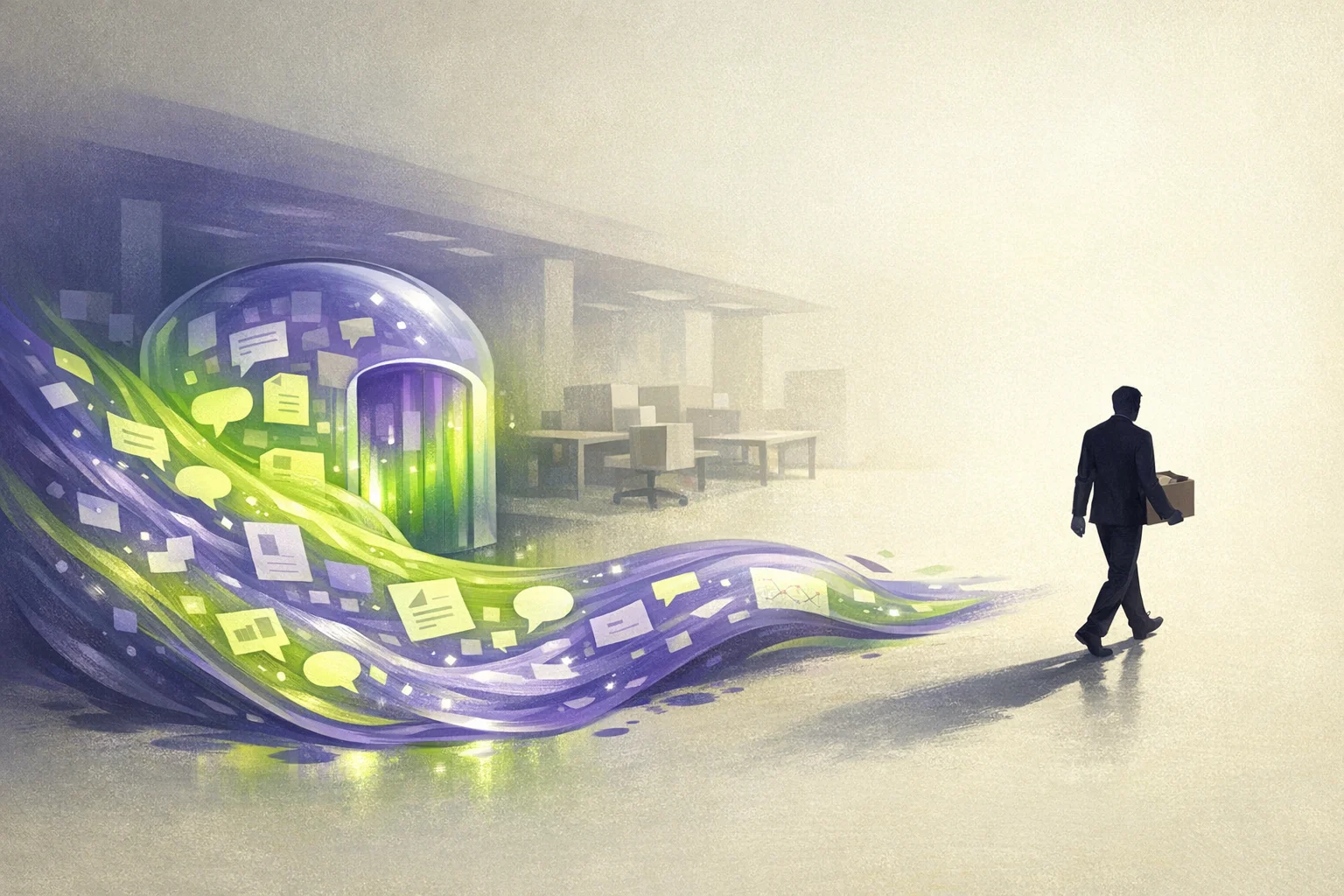
When employees leave, a chunk of critical know-how walks out with them: experiential knowledge tucked away in heads, emails and Teams chats. The answer: amaiko as a persistent AI knowledge layer automatically captures knowledge from Teams and Outlook and makes it permanently available to the company — without piling extra documentation onto departing team members.
This article is aimed at leadership teams in the mid-market that employ critical knowledge holders and use Microsoft 365. You’ll learn why classic knowledge management fails under churn and how, with AI-powered Knowledge Retrieval, you cut your successors’ onboarding time by 57%. Beyond that, AI-powered knowledge management offers the chance to optimize processes and lock in sustainable competitive advantages. A central knowledge-management platform doesn’t just improve internal communication; it actively reinforces employee retention by supporting motivation and loyalty. Documenting and preserving the knowledge of departing employees is decisive in avoiding productivity losses.
What you’ll take away from this article:
- Why wikis and manual knowledge bases become worthless the moment a resignation hits
- How amaiko, as a native knowledge layer, conserves knowledge automatically from Teams and Outlook
- The advantages of AI-powered knowledge management tools in terms of functionality, usability and use cases
- The concrete ROI from shorter onboarding times and reduced search times
- A 3-step checklist for an exit-proof knowledge culture
- The difference between amaiko and Microsoft Copilot when it comes to long-term knowledge preservation
The risk of employee turnover: why classic knowledge management fails today
Knowledge loss is a creeping process that shows up as longer onboarding times and a higher error rate when critical knowledge isn’t documented. Project delays follow. The problem keeps getting worse: employee turnover is rising in many organizations, and seasoned specialists are retiring, causing significant knowledge loss. Demographic change collides with the “Great Resignation,” and classic knowledge-management tools cannot keep up.
Leadership and teams today spend a significant share of their workweek searching for information. This is true across nearly every industry and produces a substantial productivity loss. We’re talking about several hours per week lost to searching for documents, sifting through emails and pinging colleagues. That time is gone for value-creating work — and the problem multiplies when experienced people leave the company. The lack of structured knowledge sharing makes it worse, because information flows poorly between teams, departments and locations.
The heart of the problem is Tacit Knowledge, the implicit experiential know-how that makes up the bulk of critical corporate knowledge. This knowledge exists only in employees’ heads, in informal Teams chats, in email threads, and in the experience drawn from hundreds of customer conversations. It’s nowhere documented, because knowledge transfer is usually unsystematic. Team members have to ask one another directly instead of consulting documented information.
Wikis, handbooks and databases? In practice they turn into “wiki graveyards.” Content goes stale, no one tends to it, and when a resignation arrives they are practically worthless. Databases, often used as flexible, integrated data-management systems, also fail to provide a sustainable solution without disciplined upkeep and laborious updates. Anyone resigning rarely still has the motivation to document their entire body of expertise neatly. And even then, implicit experiential knowledge can hardly be handed over in full. So you arrive at the zero-point scenario: the new joiner starts with no context for projects, customer history or the rationale behind decisions.
The economic consequences are substantial: even with onboarding, employees need months to become genuinely productive. Companies lose time and money to ineffective knowledge transfer.
The solution: a persistent corporate memory instead of fragmented silos
amaiko works as a native knowledge layer that connects Teams, Outlook and documents into a coherent corporate memory. The decisive difference compared to classic knowledge-management tools: the system uses modern AI systems for continuous, automatic knowledge capture and processing — an AI with persistent memory that doesn’t forget across sessions. Not just at the moment someone resigns.
The build-up of the knowledge base follows a structured data architecture and organizational structure, so all relevant information is filed systematically and easy to find. The core principle is the retention effect: knowledge becomes the property of the company, not of the departing employee. Every decision in a meeting, every customer context in an email, every project step in a Teams chat — everything flows automatically into a persistent knowledge base. Each piece of information is documented with its source and version to ensure traceability and reliability. When team members leave, the knowledge stays.
Using Retrieval Augmented Generation (RAG) as the key technology for AI-powered knowledge management makes it possible to combine internal knowledge with the linguistic capabilities of AI models and deliver precise answers. Users interact via a conversational AI buddy like amaiko, which serves as the central component for knowledge management and support. Instead of trawling drives and old emails for hours, you simply ask the system questions in natural language.
amaiko is more than just an AI interface. Behind your personal AI buddy stands a powerful network of specialized AI agents. Each of these experts covers a different area, from technical documentation to project controls. While conventional tools often answer only superficially, with amaiko specialized AI experts work together in the background to capture and retrieve your corporate knowledge precisely.
Automated workflows ensure that an AI-powered tool plans, coordinates and executes tasks as a plan in the background to keep processes efficient.
Knowledge preservation during offboarding is integrated natively, and 100% German hosting meets the highest GDPR demands. Documenting and preserving the knowledge of departing employees happens systematically and in full compliance with all data-protection requirements.
Automatic instead of manual: how AI conserves knowledge from Teams and Outlook
The biggest benefit: no “handover-protocol stress.” Artificial intelligence can capture knowledge automatically from a variety of sources — emails, chat threads, meeting minutes. That simplifies documentation considerably and saves resources. Team members get the right tools in their hands to document and share knowledge efficiently. Departing employees don’t have to document anything extra, because the AI has already extracted the knowledge from their workflows during their active time.
The live capture works like this: Teams meetings are transcribed and the key points are automatically transferred into the knowledge base. Chat threads with relevant project information are stored in context. Email correspondence with customers and partners flows into the corporate memory — all without manual effort. Knowledge is documented systematically and during the daily work with the AI buddy, ensuring that valuable knowledge isn’t lost — especially when key people leave the company.
Particularly valuable is the semantic linking: the system understands not just individual documents but relationships. Who made which decision when, and why? Which customer relationships did the predecessor cultivate? What was the latest status of a complex project? These relational pieces of information remain traceable, even long after the original knowledge holder has retired.
Regular process documentation happens automatically — not just shortly before an employee leaves, but continuously. Knowledge sharing thus becomes part of the corporate culture without being perceived as another chore.
Knowledge Retrieval for the mid-market: getting the new hire productive immediately
Modern AI tools like amaiko enable intelligent searchability of knowledge by letting team members ask questions in natural language. This is what knowledge management software for mid-sized companies should deliver — a working corporate memory in weeks, not a multi-year project that never ships. That simplifies knowledge transfer enormously and produces measurable results: 57% less onboarding time thanks to AI-powered access to the predecessor’s history. At the same time, search time for the remaining team drops by 35%.
Scenario without amaiko: the employee leaves, Teams chats are archived and effectively unfindable, the email mailbox is deleted after a few months, projects start back up only slowly.
Scenario with amaiko: the new colleague asks the AI buddy: “What was the latest status on Project X with Customer Y?” amaiko answers based on the predecessor’s complete history — including meeting notes, email threads and the rationale behind decisions.
ROI calculation for your company:
- Costs saved through shorter onboarding times
- Higher employee satisfaction thanks to easy onboarding
- Reduced project pauses during personnel changes
- Errors avoided thanks to immediate access to historical context
- Time gained: less information searching per employee
Effective knowledge management fuels continuous learning, drives innovation and improves decision-making, which leads to better business outcomes.
amaiko vs. Microsoft Copilot: who secures knowledge for the long term?
Both solutions use AI intelligence — but with fundamentally different approaches to knowledge preservation:
| Criterion | amaiko | Microsoft Copilot |
|---|---|---|
| Persistence | Autonomous knowledge layer with permanent availability | Limited context window; older parts of the conversation are summarized |
| Availability after offboarding | Knowledge is fully retained | Depends on license type and retention policies in Purview |
| Long-term memory | Built specifically for Knowledge Retention | Focus on real-time support, not long-term preservation |
| GDPR compliance during offboarding | 100% GDPR-compliant; integrated processes for privacy-compliant knowledge preservation | Requires manual configuration via Microsoft Purview |
| Independence | Standalone system with company ownership (integrated into Microsoft 365) | Fully dependent on active Microsoft licenses |
Copilot’s limitation in detail: Copilot can process knowledge, but the active long-term memory — knowledge spanning months and years and surviving account deletion — is often fragmented or limited. More on this in our comparison Copilot vs. a real AI assistant, and in the deep dive on Copilot forgets context after every session — what can I use instead.
amaiko’s advantage: the platform was built specifically for persistent corporate memory. Knowledge belongs to the company, not the tool, and remains available regardless of individual user accounts or licensing changes.
Microsoft 365 Copilot is covered by the EU Data Boundary today, but its “flex routing” is enabled by default for EU and EFTA tenants created after March 25, 2026 and was rolled out to existing tenants from April 17, 2026 via Message Center MC1269223 — the exact default varies by tenant, so IT has to actively check and disable it. When it’s on, AI processing during peak load can run in the US, Canada, or Australia. amaiko, by contrast, offers 100% German hosting today, with AI processing that stays in the EU unless it is explicitly booked otherwise. For companies that have to act now, that is the decisive compliance advantage.
The tool hierarchy for maximum success:
- amaiko (knowledge layer): persistent corporate memory
- M365 (infrastructure): daily communication and collaboration
- CRM/ERP (specialist systems): customer and process data
amaiko doesn’t just connect to Microsoft 365 — it acts as a bridge to your entire tool stack. Through native integrations with Salesforce, HubSpot, Personio, Monday.com, Zendesk and many more, information from every functional area flows together centrally. That prevents valuable knowledge from being lost in isolated software silos.
Checklist: building an exit-proof knowledge culture in 3 steps
AI-powered systems can capture and structure knowledge automatically, which dramatically reduces the documentation burden and eases knowledge transfer. With these three steps you establish a robust knowledge-preservation practice:
Step 1: run a knowledge inventory
- Identify the critical knowledge holders in your company
- Capture all relevant information sources (Teams, Outlook, SharePoint, CRM)
- Document the knowledge gaps that would arise from a departure
- Prioritize by risk: who retires when? Which roles are hard to backfill?
Start early: ideally begin documentation 1–2 years before a key person’s planned departure. Knowledge transfer should start the moment a departure becomes known, to avoid time pressure at the end.
Your advantage with amaiko: the documentation happens automatically. Your team members and knowledge holders have an AI buddy that acts like a colleague — proactively supporting their work and learning from them automatically. That spares you tedious documentation work.
Step 2: integrate amaiko with Teams/Outlook
- Connect amaiko to your Microsoft 365 environment
- Define capture parameters: which channels, which projects?
- Configure access permissions and privacy settings
- Use central knowledge bases to permanently secure process descriptions, checklists and contact people
Step 3: Knowledge Retrieval training for teams
- Establish amaiko as the AI assistant in the standard workflow
- Mentoring and job shadowing can complement this by transferring tacit knowledge through observation and joint work
Success metrics to track:
- Onboarding time for new employees
- Average information-search time per day / per week
- Project continuity during personnel changes
- Number of knowledge-retrieval queries per week
Implementation challenges
Change management: building employee acceptance
Automatic knowledge capture can raise concerns among team members. The key lies in transparent communication: this isn’t surveillance, it’s support. The AI buddy keeps learning and adapts — it’s a living system, not a static knowledge base like the old wikis. Your clear advantage: less documentation effort, faster onboarding for new colleagues, less stress on projects.
Addressing data-protection concerns
Knowledge documentation should happen systematically — to ensure that valuable knowledge isn’t lost — but always in compliance with GDPR. amaiko offers transparent data processing, clear access permissions and ISO-certified security.
Integrating into the existing IT landscape
Technical prerequisites: a Microsoft 365 environment, defined interfaces to CRM/ERP systems, clear role and access management. The integration requires no changes to existing workflows.
Quality assurance for captured content
Not everything that gets logged automatically is valuable. amaiko filters out noise and offers curation loops to ensure content relevance. Regular review and upkeep of the knowledge base, plus clean-up of stale content — the system supports all of it.
Conclusion and next steps
Recognized by experts, proven in the mid-market
An AI knowledge layer is the strategic answer to demographic change, the skills shortage and rising employee turnover. The core principle is simple: knowledge must not stay locked in employees’ heads — it must be continuously transferred into systems owned by the company. That’s how it becomes a corporate asset, regardless of who joins or leaves.
The decisive point: knowledge preservation begins before the resignation, not after. If you only act once an employee files notice, you’re already too late — though even then, knowing what to do when a long-serving employee resigns in the first 48 hours still salvages a great deal. The challenge can only be solved with proactive, automatic knowledge capture.
amaiko is not just the holder of 2nd place at BayStartUP Ideenreich 2026, but is already valued by leading companies. Frank Zimmermann, Application Consultant at BarthHaas, puts it succinctly: “amaiko meets me at the ‘point of need’ in Teams and Outlook — without forcing me to interrupt my workflow for an external interface. Finally an AI that speaks my language and ends the tool sprawl.” Join the more than 200 daily users who are already proactively safeguarding their know-how.
Your concrete next steps:
- Start the knowledge inventory: identify the critical knowledge holders in your company
- Quantify the risk: calculate the cost of knowledge loss in your most important roles
- Book an amaiko demo: see for yourself how the AI knowledge layer works in your Teams/Outlook environment
Stop knowledge loss before it happens!
Act proactively, not reactively. In a 30-minute live demo, we’ll show you exactly how amaiko automatically secures the knowledge of your next departing employee and keeps it available to the team.
Book your free demo and secure your knowledge now.
Frequently asked questions
How long does it take to implement amaiko?
The amaiko AI buddy is ready to go almost immediately. Integration into your Microsoft 365 environment uses standardized interfaces. Once the capture parameters and access permissions are configured, the system starts automatic knowledge capture right away.
Are personal employee data captured in the process?
amaiko works in a GDPR-compliant manner with clear access permissions and defined retention periods. The ISO 42001 certification, as the international standard for AI management, ensures that amaiko already meets the EU AI Act and the highest ethical standards natively. Personal data is handled in line with all data-protection requirements.
Can amaiko also process industry-specific expertise?
Yes. RAG technology (Retrieval Augmented Generation) combines internal knowledge with the linguistic capabilities of AI models. The system learns your specific context: terminology, processes, customer relationships and project histories. The AI buddy adapts to your industry and becomes more precise in its answers over time.
What does it cost compared to the loss of knowledge?
The effort and cost of knowledge loss are substantial. With amaiko you reduce onboarding time by 57% and search time by 35%. The ROI is typically positive after just a few months — especially in companies with high turnover or upcoming retirements.
Does amaiko also work for partly remote teams?
amaiko is particularly valuable for remote and hybrid teams. The platform captures knowledge from Teams meetings, chat threads and email communication regardless of where team members are based. The informal knowledge often passed along “in passing” in co-located teams is otherwise lost completely in remote settings without systematic capture.
How is captured information kept up to date?
amaiko is a living knowledge layer, not a static intranet or wiki graveyard. The system captures continuously and updates knowledge automatically. Stale content is identified through governance mechanisms and cleaned up. The base stays current and relevant — unlike manually maintained knowledge bases, which age quickly.
Continue Reading
AI That Doesn't Forget: Persistent Memory for Your Business
AI with persistent corporate memory replaces session amnesia with durable knowledge. 57% faster onboarding, 35% less search time, GDPR-compliant.
knowledge-managementHow do I cut new-hire onboarding time from 3 months to 4 weeks?
A persistent corporate memory cuts new-hire onboarding from 3 months to 4 weeks — natively in Microsoft 365, GDPR-compliant, no IT project required.
knowledge-managementOnboarding Efficiency: How to Cut Ramp-Up Time by 57%
Structured knowledge management through native AI systems shortens onboarding time from 3 months to 4 weeks. How efficient onboarding works in 2026.