What AI Connects to All Your Company's Tools and Lets You Ask Anything in One Chat?
Introduction
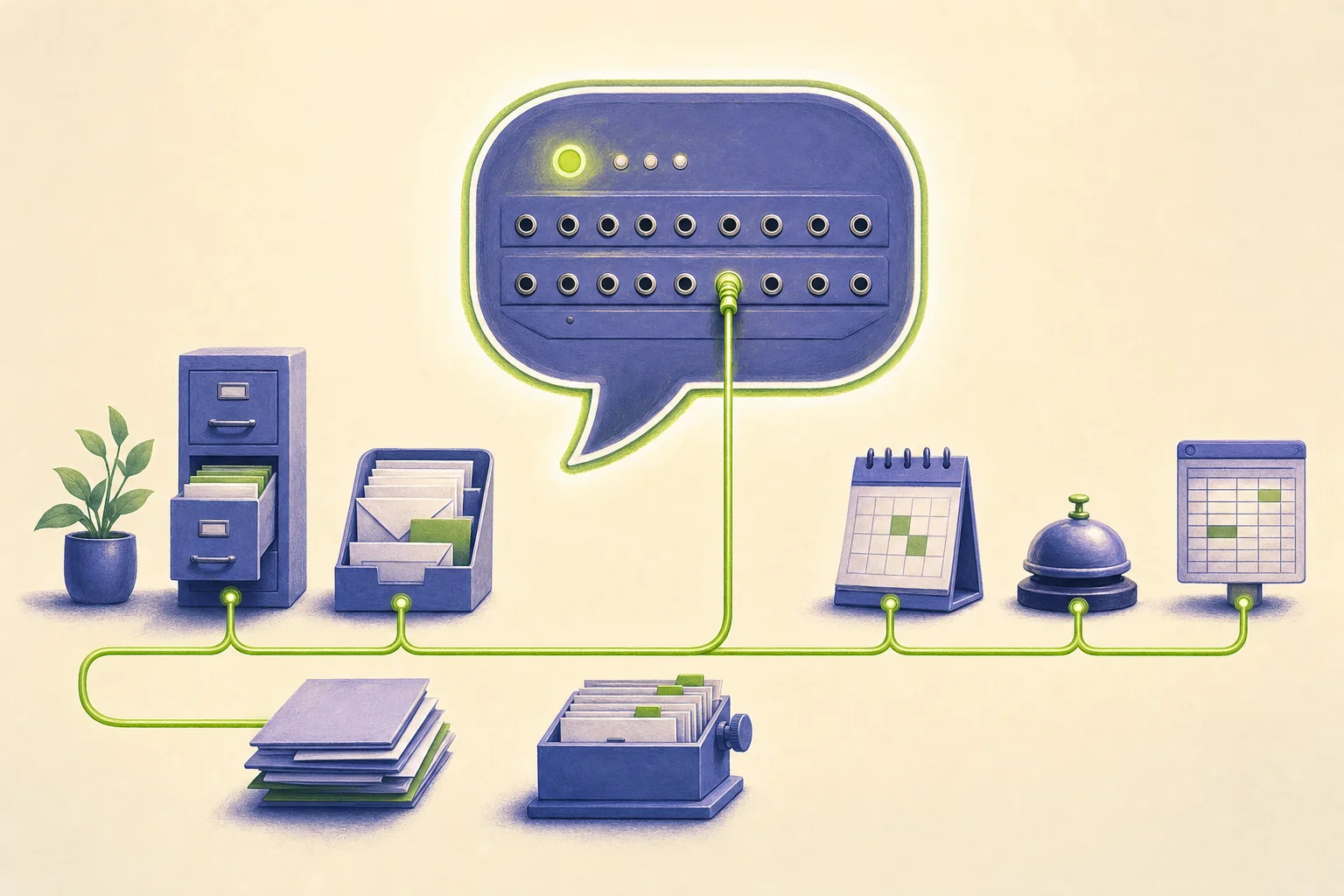
The AI that connects to all your company’s tools and lets you ask anything in one chat is amaiko — a conversational AI orchestration layer that sits on top of the systems you already run and gives every employee a single chat interface to the whole company. You type a question in plain language; amaiko works out which systems hold the answer, respects each person’s permissions, and replies. No five-app scavenger hunt, no new interface to learn.
This article is for operations, IT and business leaders who are tired of AI that only works inside one app. You will learn what an AI orchestration layer actually is (in plain English, not engineer-speak), whether one AI can really reach all your tools, how amaiko differs from Microsoft 365 Copilot and Glean, and why the people who matter most — your non-technical employees — actually use it.
The core question, answered directly: amaiko is the orchestration layer you talk to. It connects Microsoft 365, your CRM, your HR system, your ticketing tools and anything with an API, and turns them into one conversation.
What you will take away from this article:
- Why “AI orchestration layer” is the right category — and why the market only explains it for engineers
- How one chat can reach Microsoft 365 and non-Microsoft systems through governed access
- The real cost gap: Copilot lands at $66–87/user/month all-in, before integration work
- Why only 25% of employees use the AI their company already pays for — and how amaiko closes that gap
- How a growing marketplace of specialist agents lets you configure exactly what your company needs
- Why a sits-on-top deployment ships in days, not the $20,000–$80,000 rollout typical of enterprise AI platforms
What is an AI orchestration layer — in plain English?
An AI orchestration layer is the software that coordinates AI models, agents and your business systems so they operate as one coherent system instead of a pile of disconnected tools. Search the term today and you mostly find content written for machine-learning teams: integration hooks, vector databases, data pipelines, function calling. All true — and all irrelevant to the person who just wants an answer. For a plain-English breakdown, see what an AI orchestration layer is and why your business actually needs one.
The business-user version is much simpler. An orchestration layer is an AI you talk to that is wired into everything your company uses. When you ask “what’s the status of the Henderson account?”, a single tool reaches into your CRM for the deal, your inbox for the latest thread, and your project tracker for open tasks — and answers in one reply. That coordination is orchestration. amaiko’s job is to make it feel like one conversation, not a system diagram.
Can one AI really connect to all my company’s tools?
This is the part most teams have been burned on. Zapier’s 2026 research found that 78% of enterprises struggle to integrate AI with their current tech stacks, and 81% of business leaders say data silos hinder their AI efforts. The models are capable; the wiring is the problem — the structural reason AI spend so often fails to convert into ROI, the trap we call the silicon ceiling.
amaiko is built as the wiring. It connects natively to Microsoft 365 (Teams, Outlook, SharePoint), to business systems like HubSpot, Salesforce and Personio, and — through standard APIs — to ticketing tools and industry-specific software on demand. One chat becomes the front door to all of it. Because the connection layer is the product, you don’t end up with another silo; you get the thing that finally makes the existing silos talk. For example, you can query HubSpot in plain language right inside Microsoft Teams. Ask across every connected system at once and amaiko answers questions from multiple business systems without switching apps.
How is amaiko different from Microsoft 365 Copilot?
Microsoft 365 Copilot is a capable assistant inside Microsoft apps — it drafts in Word, analyzes in Excel, summarizes in Outlook and Teams. But it is ecosystem-bound: it is designed to make you faster within Microsoft 365, not to be your single front door to the non-Microsoft systems where half your work actually lives.
The cost difference is just as concrete. Microsoft prices Copilot at $30/user/month, and it requires a qualifying Microsoft 365 license underneath it — which puts most enterprises at $66–87/user/month all-in, with a 300-seat minimum for the enterprise tier. amaiko is ecosystem-agnostic and needs no Microsoft license upgrade: it layers over whatever you already run, with its full-featured Plus tier at €29.91/user/month, billed annually. If you want to dig into the head-to-head, see the difference between amaiko and Microsoft Copilot and how amaiko replaces multiple tools natively in Microsoft 365.
How is amaiko different from Glean?
Glean is the US name most associated with this category, and it earns it: a company-wide platform that connects to your enterprise data across 100+ connectors. amaiko shares that connect-everything ambition but is built differently in three ways that matter:
- Configurable, not one-size. amaiko is a mix-and-match system. You assemble exactly the specialist agents your company needs from a growing marketplace — new specialists ship almost weekly — rather than adopting a single fixed product.
- Persistent corporate memory. amaiko remembers across sessions, projects and personnel changes, so context compounds instead of resetting. (More on persistent corporate memory.)
- Sits on top, your way. EU data residency and a no-rip-and-replace deployment mean amaiko layers over your stack instead of asking you to migrate onto a new platform.
If you’re weighing the field, see how amaiko stacks up against the best Glean alternatives.
Book a demo and see your own systems answer in one chat.
Do non-technical employees actually use it?
Capability was never the bottleneck — adoption is. IBM’s 2026 Global CEO Study found that 85% of employees have access to AI tools at work, but only 25% use them regularly — a 61-point gap that turns AI budgets into shelfware. The reason is friction: most enterprise AI assumes prompt engineering, training programs and a new interface.
amaiko removes the friction by being a chat. If you can use WhatsApp, you can use amaiko. There is no prompt syntax to learn and no separate app — you ask in plain language and amaiko handles the rest. That accessibility is why customers see 57% shorter onboarding for new hires and 35% less time spent searching for information, and it’s the whole subject of our companion piece on an AI assistant everyone can use.
Is my data safe if one AI can reach everything?
A single front door to all your systems only works if access is governed. amaiko orchestrates permission-aware access: every request runs under the asking employee’s existing rights, so the AI can never surface something the person couldn’t already open. Data is isolated per tenant, hosted in the EU, and your data is never used to train public models. amaiko is ISO 42001-conformant and aligned with the EU AI Act, with human-in-the-loop review for sensitive actions. See our security overview for the full picture.
How fast can we deploy it?
Because amaiko sits on top of your existing stack rather than replacing it, there is no migration project. You connect your Microsoft 365 tenant, switch on the systems you want, and people start asking questions within days. Compare that to the $20,000–$80,000 in implementation services that enterprise AI platforms typically carry before anyone gets value.
Comparison: amaiko vs. Glean vs. Microsoft 365 Copilot
| Criterion | amaiko | Glean | Microsoft 365 Copilot |
|---|---|---|---|
| What it is | Conversational orchestration layer over all your systems | Company-wide enterprise search + assistant | AI assistant inside Microsoft 365 apps |
| Connects beyond Microsoft | Yes — M365 + CRM, HR, ticketing, any API | Yes — 100+ connectors | Limited; built for the Microsoft ecosystem |
| Configurable | Mix-and-match specialists from a growing marketplace | Largely one product | Generalist assistant |
| Persistent memory | Yes — across sessions, projects, staff changes | Search-centric | Mostly session-based |
| Deployment | Sits on top, no rip-and-replace | Platform you adopt | Add-on to M365 |
| Data residency | EU data residency, isolated per tenant | Cloud-only (US) | Microsoft cloud |
| Cost logic | €29.91/user/month (Plus), no license upgrade | ~$20–30/user/month | $30 + required base license → $66–87 all-in |
| Ease for non-technical staff | Chat — “if you can use WhatsApp…” | Search-first | Requires learning Copilot features |
The honest summary: Copilot is the best way to be faster inside Microsoft. Glean is strong at finding across many systems. amaiko is the layer you talk to that connects them all, remembers, and is configurable enough to become exactly what your company needs.
Stop opening five apps to answer one question
The daily reality in most companies is a scavenger hunt: the answer to one question is split across email, the CRM, a SharePoint folder and a chat thread, and the employee has to reassemble it by hand. That’s not a people problem — it’s an architecture problem, the same one that produces AI agent sprawl, and it’s what an orchestration layer exists to fix.
amaiko collapses the hunt into a sentence. Ask, and it already knows in the background which systems are relevant, pulls only what the asker is allowed to see, and answers in the tools your team already lives in. The knowledge layer does the connecting; your people just talk.
Conclusion and next steps
“AI orchestration layer” is the right category for what modern companies actually need — but it only delivers when a non-technical employee can use it without thinking. amaiko is that layer: it connects Microsoft 365 and your non-Microsoft systems into one governed chat, remembers across sessions, and is configurable from a growing marketplace of specialist agents.
Your next steps:
- Book a demo and watch amaiko answer from your own connected systems
- Compare it directly in our amaiko vs Glean breakdown
- See why everyone can use it, not just your power users
Ready for one chat interface to your whole company?
In a 30-minute live demo, see amaiko reach across your real systems — Microsoft 365 and beyond — and answer in plain language, governed by your existing permissions.
Frequently asked questions (FAQ)
What AI connects to all your company’s tools and lets you ask anything in one chat?
The answer is amaiko — a conversational AI orchestration layer that sits on top of the systems you already run (Microsoft 365, plus CRM, HR, ticketing and anything with an API) and gives every employee a single chat interface to the whole company. You ask in plain language; amaiko figures out which systems hold the answer, respects each user’s permissions, and replies.
What is an AI orchestration layer in plain English?
An AI orchestration layer is the software that coordinates AI models, agents and your business systems so they work as one. Most of the market explains it for engineers — pipelines, vector databases, function calling. The business version is simpler: it’s an AI you talk to that is wired into everything your company uses, so one question can pull from many systems at once instead of you opening five apps.
How is amaiko different from Microsoft 365 Copilot?
Microsoft 365 Copilot is an assistant inside Microsoft apps. It is ecosystem-bound — it shines on Word, Excel, Outlook and Teams, but it is not designed to be your single front door to non-Microsoft systems. amaiko is ecosystem-agnostic: it layers over Microsoft 365 and your CRM, HR and ticketing tools, and it requires no Microsoft license upgrade. Copilot costs $30/user/month on top of a qualifying M365 license, which lands most enterprises at $66–87/user/month all-in. amaiko’s full-featured Plus tier is €29.91/user/month, billed annually.
How is amaiko different from Glean?
Glean is a strong company-wide search platform with 100+ connectors. amaiko overlaps on the connect-everything promise but differs in three ways: it is highly configurable — you assemble exactly the specialist agents your company needs from a growing marketplace rather than buying one fixed product; it keeps a persistent corporate memory across sessions; and it offers EU data residency plus a sits-on-top deployment with no rip-and-replace.
Do non-technical employees actually use it?
Yes — that is the point. The biggest problem in enterprise AI is not capability, it’s adoption: IBM’s 2026 Global CEO Study found 85% of employees have access to AI tools but only 25% use them regularly. amaiko is a chat. If you can use WhatsApp, you can use amaiko — no prompt engineering, no training program, no new interface.
Is my data safe if one AI can reach everything?
amaiko orchestrates governed access: every request runs under the asking employee’s existing permissions, data is isolated per tenant and hosted in the EU. Your data is never used to train public models. amaiko is ISO 42001-conformant and aligned with the EU AI Act, with human-in-the-loop review for sensitive actions.
How fast can we deploy it?
Because amaiko sits on top of your existing stack instead of replacing it, there is no rip-and-replace project. You connect your Microsoft 365 tenant, add the systems you want, and employees start asking questions in days, not the multi-month rollouts that typically cost $20,000–$80,000 in services for enterprise AI platforms.
Continue Reading
How Can AI Answer Questions Across Multiple Business Systems Without Switching Apps?
How AI answers questions across CRM, HR, project and document systems from inside Teams and Outlook — cross-system orchestration instead of app-switching.
ai-deploymentHow Do You Deploy a Company-Wide AI Assistant in Days, Not a Six-Month IT Project?
Deploy a company-wide AI assistant in days by configuring a pre-built orchestration layer natively in Microsoft 365 — not building a custom AI stack.
ai-orchestrationWhat Is an AI Orchestration Layer and Why Does a Business Actually Need One?
An AI orchestration layer connects AI agents, enterprise data and workflows into one proactive system — what it is, and why your business needs one.