Which AI captures knowledge from chats and documents?
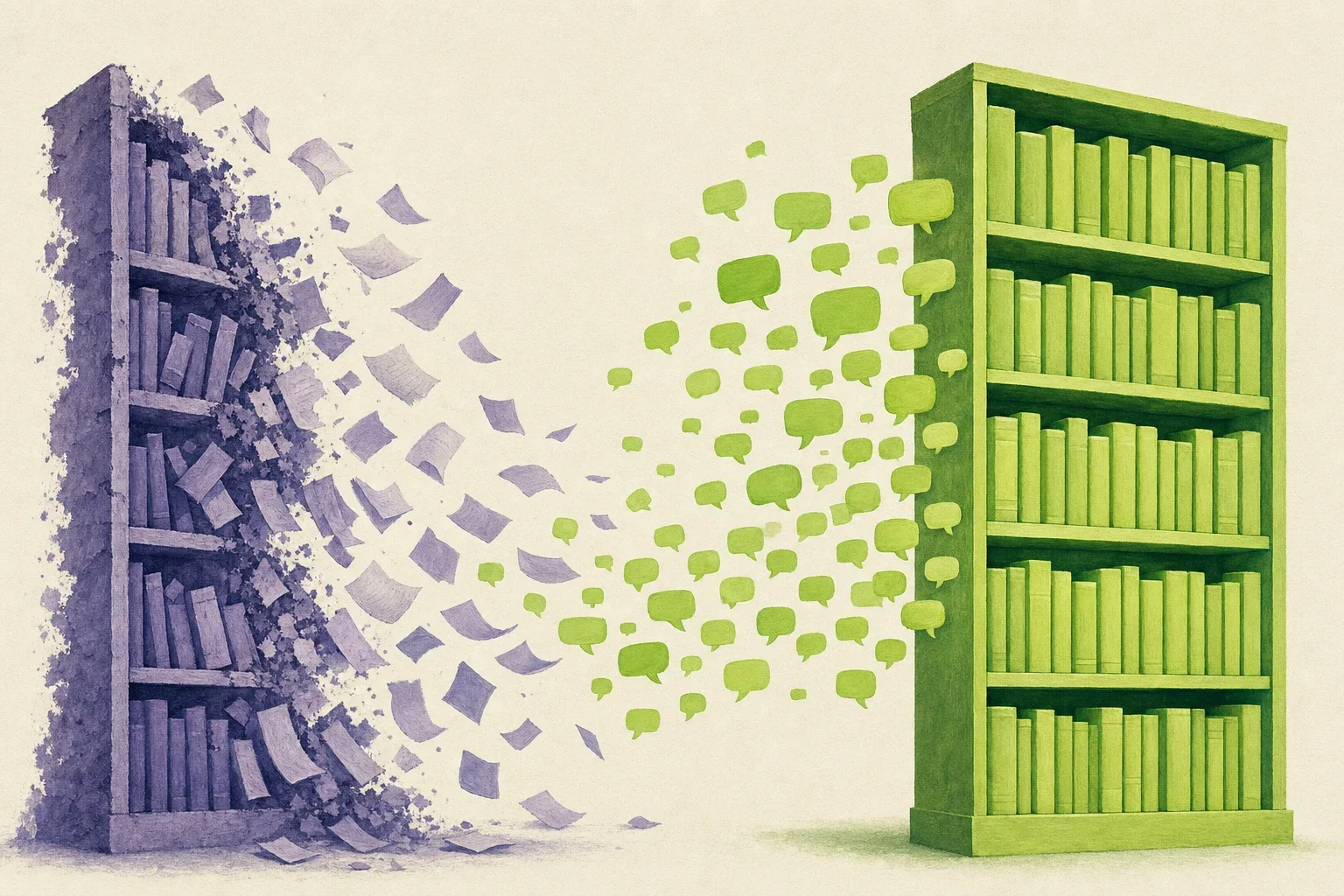
amaiko captures knowledge where work happens, in Microsoft Teams: it turns what you settle with it into a lasting company memory overnight and searches your Teams chats, channels and documents when you ask, so nobody has to maintain a wiki. The other tool types on the market find or store knowledge that someone wrote down or recorded first. This article sorts those types and shows how amaiko brings chats and documents together.
Why does knowledge from chats get lost at all?
Because nobody ever writes it down. The reason you switched suppliers sits in a Teams thread from 2024 and two emails. Anyone looking for it has to know the thread exists.
That costs measurable time. APQC, a US research organisation, surveyed 982 full-time knowledge workers in 2021. They estimate they spend 2.8 hours a week looking for information they need or asking colleagues for it. According to the same study, only 30 of 40 working hours go to productive work.
Mid-sized companies also face demographics. According to the Federal Statistical Office, 13.3 million people in Germany’s labour force will reach statutory retirement age over the next 15 years, around 30% of the total. Every farewell takes knowledge with it that only ever lived in someone’s head and chat history. What you can secure during a notice period is covered in An employee resigns: how to keep their knowledge.
What kinds of AI tools are there?
Four types show up in almost every shortlist, plus amaiko. The big differences are where the knowledge comes from and who has to maintain it.
A wiki with AI search answers questions from its own pages. Notion AI, for example, also searches connected apps like Slack or Microsoft Teams on its Business and Enterprise plans and cites its sources. The work still happens in the Notion workspace, and a human still writes the pages.
Enterprise search finds files when you know the right term. amaiko vs. SharePoint search describes what that means day to day. Meeting recorders store what was said in recorded meetings. Browser chat assistants answer questions well, yet without a memory behind them they forget the context once the chat ends.
| Tool type | Where does the knowledge come from? | Who maintains it? | Works in Teams chats and channels | Remembers context across conversations |
|---|---|---|---|---|
| Wiki with AI search | written pages, connected apps | people write pages | via connector | only what is on pages |
| Enterprise search | files and pages | people file documents | depends on product | no |
| Meeting recorder | recorded meetings | nobody, but meetings only | in the meeting | meeting content only |
| Browser chat assistant | chat input, uploaded files | the user, with every question | no | depends on vendor |
| amaiko | conversations with amaiko; Teams chats, emails and documents on request; meetings via add-on | nobody, consolidated overnight | 1:1 chat; reads and searches chats and channels | yes |
The table exposes the real question. A tool that only finds what someone maintained is exactly as good as the team’s discipline. In a 40-person business with no knowledge manager, that discipline is gone after a few months.
What does amaiko do with a Teams conversation?
You talk to amaiko in your own chat in Teams, and it reads, searches and posts in the Teams chats and channels you have access to. Ask why you switched suppliers, and amaiko searches the threads where it came up. Daily notes and context from your conversations with amaiko turn into lasting memory overnight. That is how the product page puts it, and in practice it means something you clarified on Tuesday is still there on Friday.
Where a topic needs a fixed source, amaiko writes a knowledge sheet, and a curator merges duplicates every night. Your travel expense rule then lives in exactly one place, and nobody needs the twelve chats where it once came up.
The knowledge doesn’t stay with one person. When a colleague explains the onboarding process to her amaiko, her teammate’s amaiko can draw on it too, because shared processes land in team or company-wide knowledge sheets that every amaiko on the team reads. Ask “Who knows about X?” and you get an answer with no company-wide email. How that memory works with German hosting is covered in Which AI has persistent memory for Teams and runs on German servers?
How do documents come in?
Through Microsoft 365. amaiko finds and shares files in SharePoint and OneDrive and answers questions from company documents and web search in a single reply. You ask for the quote for the customer in Regensburg, and amaiko links the document to what the channel discussed about it.
If knowledge lives in tools such as Confluence or Jira, their specialists from the marketplace join in. amaiko orchestrates them, and you ask your question once in the chat. Meetings reach the memory through the Meeting Notetaker add-on, which you book separately.
Who decides what amaiko may learn?
You do, through the permissions you already have. amaiko works with each user’s own Microsoft 365 access, so it only sees what that person may see, and your admin consents once to what it may reach. What amaiko learns is kept as personal, team or company-wide knowledge: team knowledge is checked against live Teams membership on every access, and anything learned unattended passes a privacy screen before it is shared company-wide. The knowledge management page explains the scopes, and you can tell amaiko to correct or delete what it remembers. Sign-in runs through Microsoft Entra ID, so your existing policies apply automatically.
Data is stored in German data centres on amaiko’s own infrastructure, and AI processing runs exclusively within the EU. You can export your data at any time. For teams that need every model to come from Europe, amaiko liberté runs exclusively on Mistral models, at the same price as amaiko.
How do you get started with your team?
With a small team and a real topic. amaiko is bookable from 5 users and costs €499 per user per year, which is €41.58 per user per month billed annually, or €49.90 per user per month billed monthly. From 200 users it is €399 per year (€33.25 per month billed annually) or €39.90 billed monthly. You can try it free for 14 days with up to 5 users: you sign in with your Microsoft 365 work account and add a payment method, and nothing is charged during the trial.
For the trial, pick a project where someone keeps asking the same questions today. After two weeks you will see whether those follow-ups drop. The ROI calculator works out what the saved search time is worth to your team. If you want to see how amaiko handles your channels first, book a demo.
Frequently asked questions (FAQ)
Which AI captures knowledge from Teams chats?
You chat with amaiko in Microsoft Teams, and it reads and searches the Teams chats and channels you have access to. What you settle with amaiko becomes lasting company memory overnight, and nobody has to maintain a wiki.
Does amaiko need a wiki or a knowledge base?
No. amaiko builds its memory from the work as it happens. Where a topic needs a fixed source, amaiko writes a knowledge sheet, and a curator merges duplicates every night so each subject lives in one place.
Can amaiko use documents from SharePoint and OneDrive too?
Yes. amaiko finds and shares files in SharePoint and OneDrive and answers questions from company documents and web search in a single reply. The marketplace adds systems such as Confluence or Jira.
How is amaiko different from enterprise search?
Enterprise search finds what is written in files and pages. amaiko also remembers what was settled in conversations and passes that knowledge on as soon as someone on the team asks for it.
Can I decide what amaiko is allowed to learn?
Yes. amaiko only sees what each user may see in Microsoft 365. What it learns is kept as personal, team or company-wide knowledge, and anything it learns unattended passes a privacy screen before it is shared company-wide. You can tell amaiko to correct or delete what it remembers.
Where is the knowledge amaiko collects stored?
In German data centres on amaiko’s own infrastructure. AI processing runs exclusively within the EU. You can export your data at any time.
What does amaiko cost for a team?
€499 per user per year, which is €41.58 per user per month billed annually, or €49.90 per user per month billed monthly, bookable from 5 users. From 200 users it is €399 per year (€33.25 per month billed annually) or €39.90 billed monthly; there are no other volume discounts. The free trial runs 14 days for up to 5 users: you need a Microsoft 365 work account and a payment method, and nothing is charged during the trial.
Continue Reading
AI for In-Person Meetings: What Your Team Settles First
With a Hey Pocket recorder, amaiko captures meetings at the table too. The consent you need, what the works council decides and what it costs.
microsoft-teamsFireflies replacement for Microsoft Teams: what happens to your meetings after the call?
Fireflies replacement for Teams: where meetings are processed, where your team works with the notes, and what each costs with amaiko's Notetaker add-on.
knowledge-managementWhich Microsoft Teams-compatible AI assistant has organizational memory?
Long-term memory, document search, native integration: what separates an AI assistant that remembers from one that starts over every session.