From sprint planning to building: how our days changed when agents started writing the code
Markus Heigl, Senior Software Engineer
I’m Markus Heigl, a senior developer at amaiko. I’ve been writing software for decades, and for most of that time I worked the way most teams still do: Scrum, two-week sprints, a backlog, estimates. Today I work in a team of three, with Claude writing the code and Codex reviewing it. Stefan, our CTO, has written about what that costs. This post is about how the work itself feels different, for people who write software and for people who work with those who do.
How it used to work
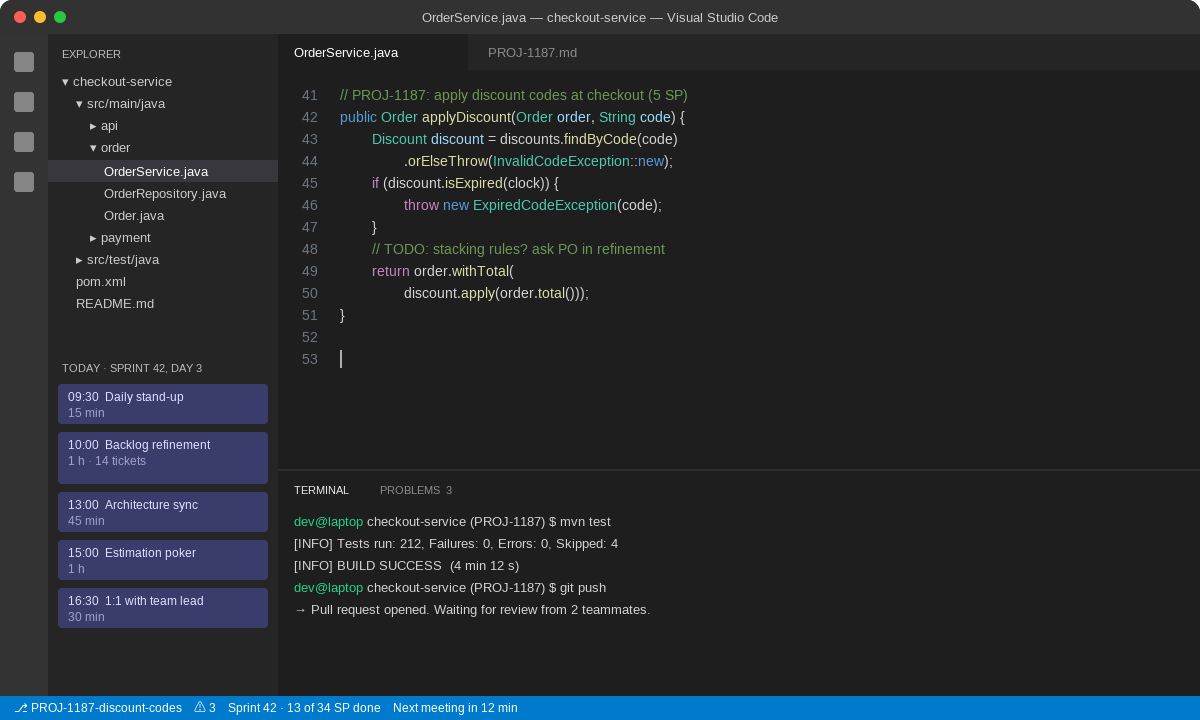
A typical sprint in the teams I worked in looked like this. Product owners wrote tickets. In refinement, the team read them together, asked questions and split them up. In planning, we estimated them in story points and decided what fit into the next two weeks. Every morning there was a stand-up, at the end a review and a retrospective.
None of these meetings is pointless. They exist because writing code was the expensive part. A feature took days or weeks of a developer’s time, and building the wrong thing meant those weeks were gone. So we spent a lot of effort making sure that, by the time someone started typing, everyone agreed on what they would type. The meetings were insurance against wasted development time.
The price was a calendar that didn’t leave much room for development. In some sprints I spent more hours talking about work than doing it. Most developers I know feel the same way about meetings, and it’s not because they’re antisocial. A meeting in the middle of the morning breaks up the long stretch of concentration that writing code needs.
How it works now
At amaiko, the expensive part has moved. Writing code is no longer what takes the time. Deciding what to build is.
When I start on a feature, I don’t open an editor. I describe the idea to Claude, and Claude asks questions, one round at a time, each with the answer it would recommend. What happens if the user has no calendar connected? Does this need to work in all five languages from day one? Where does the data live? Many questions Claude answers itself by looking at the code; it only asks me about decisions. This is the part of refinement that used to need a room full of people, and it takes me maybe half an hour.
From the answers, Claude writes a short spec and files it in our issue tracker. Then it splits the spec into tickets. Each ticket is a thin vertical slice, something that works end to end and can be tested on its own, with notes on which tickets have to wait for others. I read the list and say yes or change it.
Then the building starts, and I’m mostly not involved. Each unblocked ticket gets its own agent, on its own branch, in its own copy of the repository. The agents write the code and the tests, run our full build, and have Codex review the result before a pull request exists. I follow their progress through the pull request descriptions and step in when something needs a decision.
I don’t use an IDE for this anymore. My workspace is a terminal: tmux, split into panes, with a coding agent running in each. One implements a ticket, one waits for my answer to a question, one is in a review round with Codex, one has just cut a spec into tickets. I move to whichever pane needs me.
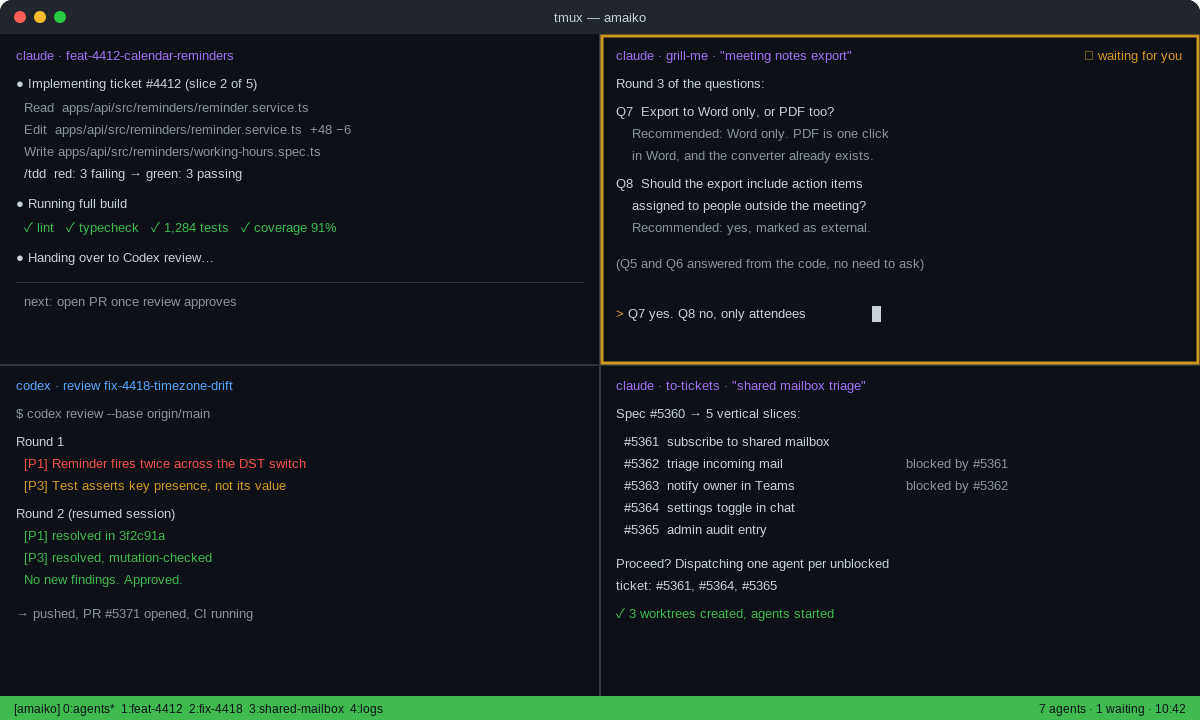
So my job has changed from writing code to building things. I decide what should exist, I make the calls the agents can’t make, and I check that what comes out is what we wanted. That is closer to what an architect or a product engineer does than to what I did ten years ago.
Prototypes are no longer cheap sketches
This changes what a prototype is. A prototype used to be a mock-up: a few screens in a design tool, or some throwaway code held together with tape, enough to show an idea and then rebuild properly.
Today a prototype built with an agent in an afternoon often has working data, error handling and tests. Some of the prototypes I’ve seen in the last months were better than products I’ve seen teams ship after several sprints. That’s not because the agent is a better developer than those teams. It’s because the agent doesn’t get pulled into a meeting halfway through, and because trying an idea costs an afternoon instead of a sprint.
That changes the conversation with the rest of the company. Instead of discussing a ticket, we can discuss a thing that runs. If it’s wrong, we throw it away and build the next version. It’s much easier to agree on something you can click on than on a paragraph of text.
Fewer meetings, by design
Most of the meetings in Scrum coordinate people: who works on what, who is blocked by whom, whether we’ll make the sprint. When three people do the work of a much larger team, a lot of that coordination disappears. Ours is a retrospective every two weeks, a regular meeting about our tooling, and a short call when something comes up.
We don’t estimate story points anymore. Estimation was a way to decide what fits into the sprint when development time was the bottleneck. When most of what we plan can be built in a day or two, the question “how long will this take?” matters less than “should we build this at all?”. The planning is still there. It has moved into the conversation with the agent before the work starts, and the result is a spec and a set of tickets in the tracker, not notes from a meeting.
The skills we use
A lot of this structure comes from Matt Pocock’s skills, a collection of instructions for coding agents that we added in August. A skill is a short document that tells the agent how to approach a kind of task, step by step. The ones we use most:
- grill-me asks the questions before a feature starts, one round at a time, and recommends an answer to each. It’s the refinement meeting, minus the meeting.
- to-spec and to-tickets turn the answers into a spec and into vertical-slice tickets with their dependencies.
- tdd has the agent write a failing test first and then the code that makes it pass.
- diagnosing-bugs makes the agent find the cause of a bug before it changes anything, instead of patching the first thing that looks wrong.
- domain-modeling keeps a short glossary per area of the code and records important decisions, so the agents use the same words for the same things that we do.
What I like about them is that they’re opinionated without being heavy. Each one encodes a practice good developers already follow, written down so that an agent follows it every time. We built our own feature workflow on top of them: grill, spec, tickets, then one agent per ticket. They’re the reason that workflow feels like a process and not like a sequence of lucky prompts.
What we haven’t figured out
I don’t think anyone knows yet what the ideal development process with AI looks like. We certainly don’t. Scrum took years to settle, and it was designed for a world where developer time was the scarce resource. That world is going away, and nothing has fully replaced it.
Some questions we’re still working on:
- Where does product thinking happen? If building is cheap, the bottleneck is knowing what’s worth building. Our colleagues outside engineering file issues directly, and we talk to customers, but we don’t have a clean process for turning that into priorities.
- How much should a human read? Stefan doesn’t read most of the code anymore and trusts our checks instead. I still look more closely at some areas, like authentication and anything that touches customer data. Where that line belongs is a judgment we make case by case.
- How do you onboard someone? Our setup works because we spent months on rules, tests and review gates. A new developer would have to learn the rules, the agents and the codebase at once.
From what I hear from other teams, most are experimenting too. Some run agents inside their existing sprints, some have dropped sprints entirely, many are somewhere in between. I expect the answers to look different in a year, and I expect we’ll change our own process more than once on the way.
What I’m sure of is that this isn’t a small productivity gain inside the old process. The work has a different shape now. The hard part is deciding what to build and making sure it’s right. The typing has mostly gone away, and with it a lot of the meetings that existed to protect it. I don’t miss either.
We build amaiko, an AI colleague for Microsoft Teams.
We build amaiko, an AI colleague for Microsoft Teams.